Comanche
News of the WorldThe Comanche are presented as a people whose movement across Texas determines where settlers travel, how they defend themselves, and what they believe about the land around them. The novel portrays raiding as a deliberate response to geography and opportunity, not as an isolated rumor: open country offers visibility, while the Hill Country offers concealment, water, isolated farms, and loot. Their presence is also part of a larger Indigenous history that the book records through both conflict and memory, though it distinguishes the Comanche from the Kiowa and other peoples rather than treating them as one group.
Territory, Movement, and Raiding
The novel places the Comanche’s principal approach from the north, down from the Red River and across the open, arid country around Lampasas. In that exposed terrain, the dust of a moving party could be seen for miles, so raiders skirted towns and forts. Southward, the Hill Country offered a different kind of country: hidden approaches, water, and scattered farms, with no soldiers reliably positioned to stop them. The Captain’s journey south becomes a study in how this geography governs danger. He rides ahead to watch the road and repeatedly stops on rises to look and listen for signs of riders, while planning to cut a packhorse loose and flee with Johanna if an attack comes.
A cavalry major warns the Captain that there are raiders in the Hill Country, but says he is under orders and cannot simply go where he pleases. The gap between warning and protection recurs across the route. Near the road to Lampasas, four armed horsemen block the travelers and describe the Comanche and Kiowa as driving people out of the Hill Country, where cover makes it hard to see an approach. Their warning gives the Captain practical information, but also reveals how thoroughly the threat has emptied or unsettled the country through which he is traveling.
Settlements and Civilian Fear
The novel shows raiding shaping ordinary decisions as well as military ones. In Bandera, freight wagons and teams of oxen assemble in the street for a convoy to San Antonio, using collective travel as protection against the Comanche. Yet the town’s confidence rests partly on a false rule: residents believe the red men come only at the full moon, although evidence contradicts that belief and the moon has already passed full. The contrast between a heavily organized convoy and this comforting superstition captures the uncertainty in settler life. Preparation is necessary, but local explanations can also become delusions of safety.
Fredericksburg, described as almost entirely German and beleaguered, is vulnerable in a different way. Its wide main street could give warriors a straight passage through town, allowing them to fire in both directions. The Captain’s arrival with Johanna attracts attention because residents have heard of captives returned from Indian Territory and of the silver paid for their return. They respond to returned captives with fearful speculation, imagining that their unfamiliarity with white society must have been caused by a secret potion or drug. The episode shows how stories of captivity circulate alongside reports of raids, shaping public attitudes even when those stories distort the people they describe.
The Road, Rumor, and Public Authority
The dangers described along the route are not always followed by an attack, but they still govern movement. The Captain and Johanna pass a company of cavalry moving from San Antonio to Fort Sill, and the major’s warning about raiders reaches them without bringing direct protection. Elsewhere, local men claim that Comanche and Kiowa parties use the Hill Country’s cover and water to drive residents away. The journey therefore passes through overlapping forms of authority: military orders, local warnings, armed civilians, and the travelers’ own preparations. None offers a complete guarantee of safety.
The novel also sets this danger against the weakness of Reconstruction-era local government. In Erath County, a black-bearded spokesman explains that there is no sheriff, justice of the peace, mayor, or commission; the previous officials have been removed and no replacements sent. His group has taken on the job of governing and insists that travelers answer to it. The Comanche are not the cause of this particular political vacuum, but the missing institutions form part of the same unsettled landscape in which civilians fear raids and protection is uncertain. The Captain must negotiate with people claiming local power while continuing to watch for dangers on the road.
Different Peoples and Narrative Perspective
The account repeatedly places the Comanche alongside the Kiowa in settler warnings about raids, but it does not make their identities interchangeable. At the flooded Red River, the Captain sees a party of Indians across the rising water; the scene identifies Johanna’s call to them as Kiowa, and her longing is specifically for her Kiowa family and life on the Plains. Elsewhere, her Kiowa language and actions reveal a cultural world that the surrounding white characters cannot simply absorb into their own explanations. These scenes matter to the depiction of Indigenous presence, but they should not be reassigned to the Comanche: the novel marks a difference between the people named in the raiding reports and the people Johanna is trying to reach.
The narrative often reaches the Comanche through settlers’ warnings, military movements, and the Captain’s calculations. That perspective makes their effect on roads, towns, and household decisions highly visible, while leaving fewer individual Comanche voices or scenes of daily life. Yet the people are not rendered as a mere rumor. Their movement is connected to particular terrain and tactical choices, and their continuing capacity to act is reflected in the measures civilians take to avoid them. The book’s account is therefore both concrete about the consequences of raiding and limited by the viewpoint through which much of that danger is reported.
Military Defeat and Historical Memory
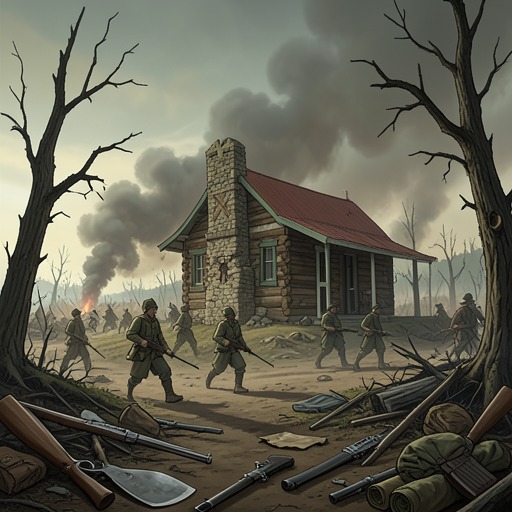
The book eventually marks a decisive change in the conflict: Colonel Ranald Mackenzie drives the last holdouts among the Comanche and Kiowa into Palo Duro Canyon, and the Indian Wars come to an end. This is presented as a military conclusion, not as the disappearance of Indigenous people from the story’s memory. Earlier, the Captain and Johanna travel through volatile Texas collecting dimes and reading news of a changing world; the account places that everyday labor alongside the campaign that closes the wars, making the road’s continuing routines part of a landscape undergoing political and military transformation.
In the closing historical perspective, the novel locates Indigenous survival not only in events but in the stories that continue to be told. It says that the bones of Kiowa warriors do not lie in the earth in the same way as the graves of settlers, but remain in accounts of their lives, bravery, and daring. That remembrance also names the death of Britt Johnson and his men and recalls Johanna as the little girl taken from the Kiowa by the Indian Agent. These references concern Kiowa history, not Comanche identity, but they complicate any simple account of the wars as an ending: military defeat closes one chapter of conflict, while Indigenous lives and losses persist in communal memory.